
August 2026
Reserves rebounded to 8.01 billion USD, but a new by-product mining tax adds to the export ban and the overall outlook eases to 6.2 out of 10. We track the open items for the next edition.
1. Strategic Scorecard
Scores are analyst judgements on a 1–10 scale (10 = strongest), based on publications monitored during the month. Arrows show direction against Edition No. 2 (1–31 July 2026), which serves as the comparison baseline. Where no new in-period data was published, the score is explicitly held rather than re-rated.
Category | Score | MoM | Key drivers |
|---|---|---|---|
Economic Growth | 7 / 10 | ► | BCC: 5.7% for 2026; IMF: above 5.5%. No new print in August; score held rather than re-rated. |
Inflation | 7 / 10 | ► | Latest reading 2.9% YoY (Q2), cumulative 4.8% at end-June. No August print obtained; held pending September data. |
Fiscal Stability | 7 / 10 | ► | Law 26-032 (7 Aug) completes the budget; invoicing moratoria ended. Offset by an unreconciled 571bn CDF gap vs the enacted figure (App. C). |
Banking Sector | 7 / 10 | ► | FATF mission expected in Kinshasa in August; no outcome published by cut-off. Egmont was credited in Edition No. 2, not recounted. |
Investment Climate | 6 / 10 | ▼ | New by-product tax (55% coefficient) layers fiscal burden onto the export ban; waivers remain at ministerial discretion. |
Mining Sector | 5 / 10 | ▼ | By-product taxation adds to the export ban and cobalt quotas. Cumulative regulatory load is now the sector's determining variable. |
Political Risk | 4 / 10 | ► | No improvement. Washington and Doha remain stalled on FDLR/RDF sequencing; eastern security unchanged. |
Currency Stability | 7 / 10 | ▼ | Franc gave back ~0.9% to 2,271.13 (7 Aug) from ~2,250 at end-July; spread 48.60 CDF. Partly offset by the reserve rebound. |
Business Confidence | 6 / 10 | ► | No official index. Indicators mixed: reserve reconstitution and a completed budget framework vs a heavier mining compliance burden. |
Overall Economic Outlook | 6.2 / 10 | ▼ | Down from 6.8. Fundamentals held; mining fiscal and regulatory load deteriorated; FATF outcome unknown. |
Baseline scores, Edition No. 2: Growth 7, Inflation 7, Fiscal 7, Banking 7, Business Climate 7, Mining 6, Political 4, Currency 8, Confidence 6, Overall Outlook 6.8.
2. Summary
August 2026 was a month of consolidation rather than redirection. The determining developments were fiscal and administrative: the supplementary budget completed its legislative passage, a by-product mining taxation regime surfaced alongside the already-known concentrate export ban, and the tax administration ended its moratoria on standardised invoicing. Against this, the reserve position recovered markedly from July's unexplained drawdown, while the franc gave back a fraction of its quarterly gain.
The most favourable development of the month is the reserve rebound. Reserves had fallen 548 million USD over July to 7.72 billion at 23 July, pushing import cover below three months for the first time in the series. By 6 August they stood at 8,009.81 million USD, restoring cover to 3.06 months and returning above the symbolic 8-billion mark. This recovery answers half the question Edition No. 2 raised: the drawdown did not continue into August. It does not answer the other half, since the Banque Centrale du Congo has still published no explanation for the July decline.
On the fiscal side, President Tshisekedi promulgated the supplementary budget as Law 26-032 on 7 August. The text completes a process Edition No. 2 already reported as enacted in July: it is a procedural milestone, not a new budget decision. It does, however, surface a discrepancy this report treats as unresolved. The promulgated envelope is reported at 50,866.3 billion CDF, against 50,295 billion recorded at parliamentary passage in Edition No. 2. This 571-billion-CDF gap, roughly 250 million USD, is unexplained by any panel source; it is logged in Appendix C rather than silently reconciled.
Mining policy tightened further, and this is where scores deteriorated. The measure disclosed on 6 August carries a fiscal component that drew far less attention than the export prohibition itself: taxes on mining by-products will now apply to minerals present at trace and ultra-trace levels recovered during refining, assessed on a 55% valorisation coefficient and levied on top of existing royalties. For integrated operators who already refine domestically, a measure widely read as low-impact becomes a direct margin question. Added to the ban's discretionary waiver regime and the existing cobalt quotas, cumulative regulatory load is now the sector's determining variable — hence the fall in both the Mining Sector and Investment Climate scores.
Copper prices worked in the country's favour. LME three-month copper rose 1.8% to 14,369.50 USD/tonne on 6 August as the export ban became public, its highest level since 29 January, when the metal set a record 14,527.50 USD/tonne. Prices therefore strengthened through the period rather than softening, and remain above the assumption embedded in the budget.
Two things did not move. The Banque Centrale du Congo held its policy rate at 12.5% following July's cut, and the eastern security picture was unchanged, with the Washington and Doha processes still stalled on the sequencing of FDLR neutralisation against Rwandan force withdrawal. The single largest open item at cut-off is the FATF on-site mission, expected in Kinshasa during August as the final gate before the October plenary decision on grey-list exit. No panel source published an outcome, and this report does not presume one.
Direction of the economy. The macro-financial trajectory held while public-policy risk increased. Reconstituted reserves, a broadly stable franc, an unchanged policy rate and a now-operative budget framework compose a stable macroeconomic configuration. The counterpart is that a growing share of outcomes now depends on discretionary administrative decisions — waiver grants, valorisation coefficients, quota allocations — rather than predictable rules. Since the Edition No. 2 baseline, the overall outlook eases modestly from 6.8 to 6.2, with the deterioration concentrated in mining-policy execution and uncertainty over the FATF outcome.
3. Major Financial Developments of the Month
Developments are presented in descending order of estimated significance. Fact is distinguished from analysis in each entry: the summary reports what was published, the implications reflect the author's interpretation. Only developments that occurred, or were first disclosed, during 1–31 August 2026 appear here; items already reported as new in Edition No. 2 are carried in Section 3 bis with their updated position.
Editorial note on volume. The brief specifies 10–20 major developments per edition. August produced seven in-period developments of material significance. Reaching a higher count would have required presenting Edition No. 2 items as new; the count has therefore been kept at seven rather than artificially padded.
1. Supplementary budget promulgated as Law 26-032 High
7 August 2026 · 7sur7.cd; Africtelegraph; Ministry of Finance
President Tshisekedi signed the amended 2026 finance law, registered as Law 26-032, balancing revenue and expenditure at 50,866.3 billion CDF. Coverage frames this as roughly a 6.4% reduction against the original 54,335.8-billion-CDF law. With promulgation, the supplementary budget acquires force of law and becomes the operative framework for the rest of the fiscal year.
Data note. Edition No. 2 recorded the enacted envelope at 50,295 billion CDF (a 7.4% reduction) at parliamentary passage. The promulgated figure reported here is 571 billion CDF higher, roughly 250 million USD. No panel source explains the difference. Both figures are carried in Appendix C and neither is treated as superseding the other.
Economic implications. The substantive fiscal decisions were made in July and analysed in Edition No. 2; promulgation completes that process rather than adding to it, and the Fiscal Stability score is held accordingly. What is new, and material, is the gap. A quarter-billion-dollar divergence between the figure Parliament passed and the figure in the promulgated law reflects either a late revision, a reporting error, or a difference in what each total covers. Until reconciled, any execution analysis built on either number carries that uncertainty, and H2 revenue should be modelled as a range rather than a point.
2. International reserves rebound to 8.01 billion USD, import cover restored above three months High
6 August 2026 (published 14 August) · BCC conjuncture note; ACP
Gross international reserves stood at 8,009.81 million USD, up 92.79 million against 30 July, representing 3.06 months of import cover for goods and services. This follows the July trajectory reported in Edition No. 2, in which reserves fell from 8,267.8 million on 2 July to 7,719.8 million on 23 July, with cover slipping to 2.97 months.
Economic implications. Measured against the 23 July trough, this is a recovery of roughly 290 million USD in two weeks, settling the first half of the question Edition No. 2 posed: the drawdown did not continue. Cover returning above three months restores the buffer that made the easing cycle look costless. The second half of the question remains open and matters more. The BCC has now gone over a month without explaining a 548-million-USD decline, and a reserve series that moves by a third of a quarterly build without commentary is itself a transparency gap. A rebound as fast as the fall is consistent with the FX-sales interpretation advanced in Edition No. 2, but consistency is not confirmation.
3. New tax regime on mining by-products introduced alongside the concentrate export ban High
Disclosed 6 August 2026 · TRT Afrika; Reuters
The August mining measure carries a fiscal component in addition to the export prohibition. Taxes on mining by-products will apply to minerals present at trace or ultra-trace levels recovered during refining, assessed on a 55% valorisation coefficient, and levied in addition to royalties already collected on the principal ore.
Economic implications. This is the least-reported element of the August package and probably the most consequential. Commentary on the export ban concluded that impact would be limited because most Congolese copper and cobalt is already refined domestically. By-product taxation inverts that logic: it falls precisely on operators who do refine locally, and reaches minerals recovered incidentally rather than mined deliberately. Germanium and rare-earth recovery, which the Mines Ministry has been encouraging, becomes more expensive exactly as the state asks operators to move up the value chain. It is a fiscal instrument dressed as an industrial one, and the main reason the Mining Sector score falls to 5.
4. LME copper reaches 14,369.50 USD/tonne on disclosure of the export ban Medium
6 August 2026 · Reuters (via Mediacongo); LME
Following Reuters' disclosure of the concentrate export prohibition, LME three-month copper gained 1.8% to 14,369.50 USD/tonne, its highest level since 29 January 2026, when the metal reached a record 14,527.50 USD/tonne. It was trading around 14,300 USD later the same session.
Economic implications. Copper strengthened through the period rather than weakening, and remains above the exchange-rate-adjusted budget assumption. The immediate driver was a supply-risk reading of the Congolese announcement, a reminder of how tightly the copper curve now responds to Congolese policy signals. For the Treasury this is favourable in the short run, since export receipts and the royalty base both improve. It also raises the cost of any future step markets interpret as supply-restricting, since the price response makes the fiscal consequence of miscalibration immediately visible.
5. Revenue administration ends moratoria on standardised invoicing Medium
6 August 2026 · Ministry of Finance
The Minister of Finance closed the ministry's tax-clinic programme and announced the end of moratoria on the facture normalisée, the standardised invoicing regime.
Economic implications. Ending the moratoria converts a nominally mandatory regime into an actually enforced one, the harder half of any invoicing reform. It bears directly on the 6.9% own-revenue uplift assumed in the supplementary budget, since both VAT and profits-tax collection depend on invoice traceability. Modest in presentation, the measure is large in mechanism: it is one of the few levers available to raise domestic revenue without new rates, and will serve as a useful proxy for whether the administration can enforce compliance beyond the largest taxpayers.
6. Franc gives back part of its quarterly gain Medium
7 August 2026 (published 14 August) · BCC conjuncture note; ACP
The Congolese franc weakened on both segments, settling at 2,271.13 CDF per dollar on the indicative market and 2,319.73 on the parallel market, with the spread between the two holding at 48.60 CDF. Year-on-year the currency showed depreciation of 3.95% interbank and 0.41% parallel.
Economic implications. Against Edition No. 2, which recorded roughly 2,250 CDF and a 1.95% quarterly appreciation, this is a give-back of about 0.9%. The franc is best described as broadly stable through 2026 following the sharp 2025 appreciation, not as being on a depreciation trend, and this report corrects the framing accordingly. The narrow, stable parallel spread is the more informative signal: at 48.60 CDF it indicates the official rate is not being administratively held away from market-clearing levels, the condition under which a managed float remains credible. Currency Stability falls only a point, since the give-back is small and the reserve rebound offsets part of it.
7. FATF on-site mission expected during August; no outcome published High
Expected August 2026; unresolved at cut-off · Zoom Eco; DeskEco; AfricaNews RDC (all pre-mission)
The FATF's June plenary in Paris recognised that the DRC had substantially completed all twenty-three items in its action plan, with an expert mission expected in Kinshasa during August to verify effective implementation, durability, and continued political commitment. A favourable conclusion would open the way to grey-list removal at the October plenary. Government preparation continued into late July under the Ministry of Finance and CENAREF.
Economic implications. This is the highest-value open item of the month, and this report declines to guess at it. Every source located during the cycle predates the mission; none confirms it took place, how it was conducted, or any signal from assessors. Since grey-list exit is the single change that would most directly reduce correspondent-banking friction, and trade finance is the binding constraint on private-sector growth, the absence of published information is itself worth recording. The Banking Sector score is held rather than raised precisely because Egmont admission was already credited in Edition No. 2 and the mission outcome remains unknown.
3 bis. Follow-Up on the Previous Edition
Items carried forward from Edition No. 2
These items were reported as new in the July edition and remain live. They are listed with their current position rather than re-narrated, so monthly readers are not served the same analysis twice.
Item | First reported | Position at end of August | Status |
|---|---|---|---|
Concentrate export ban | Ed. No. 2, item 3 | Order dated 29 June, disclosed 6 August. In force and unchanged in substance. August's fiscal layer (by-product taxation) is reported as a new development in Section 3; the prohibition itself is not re-reported. | Unchanged — fiscal layer added |
BCC easing cycle at 12.5% | Ed. No. 2, item 1 | Policy rate held at 12.5% through August, with no Monetary Policy Committee meeting or decision. Cumulative easing since October 2025 remains 1,250 bp. | Held — no new decision |
CENAREF admission to the Egmont Group | Ed. No. 2, item 4 | Admitted 10 July. Already credited in Edition No. 2 and not re-counted. Its practical significance now hinges on the FATF mission outcome, reported as an open item in Section 3. | Superseded by FATF mission |
July reserve drawdown | Ed. No. 2, item 5 | The 548-million-USD July decline remains without official BCC explanation. The level itself has recovered, reported as a new development in Section 3. | Level recovered — cause unexplained |
Eastern security, Washington and Doha processes | Ed. No. 2, §1 political risk | No improvement during the period. Sequencing between FDLR neutralisation and Rwandan force withdrawal remains unresolved; sporadic fighting continues in North and South Kivu. | Unchanged |
Closeout of Edition No. 2 watchlist items
Every item on the previous edition's watchlist is resolved, partially resolved, or explicitly marked unresolved. Items that produced no data are recorded as such rather than dropped, so the series does not quietly abandon questions it raised.
Edition No. 2 watchlist item | Status | Finding |
|---|---|---|
1. FATF on-site mission (August) — conduct and signals | Unresolved | No panel source published confirmation that the mission took place or any indication of its conduct. All coverage located predates the mission. Carried forward as the top item for Edition No. 4. |
2. Weekly reserve data — did the drawdown continue, was an explanation offered | Partially resolved | Resolved on level: reserves recovered to 8,009.81 million USD by 6 August and cover returned to 3.06 months; the drawdown did not continue. Unresolved on cause: no BCC explanation has been published. |
3. Kamoa-Kakula waiver status and Chamber of Mines response | Unresolved | No waiver decision or Chamber of Mines statement was located in the panel during the period. The by-product taxation regime has since broadened the question beyond waivers alone. |
4. Weekly inflation prints — sustained breach of 0.20% | No data | No weekly or monthly August print was obtained from the panel. The latest available reading remains 2.9% year-on-year for Q2. The Inflation score is held rather than re-rated on this basis. |
5. World Bank Country Partnership Framework — consultation to commitment | No movement | No CPF development was located during the period. Energy-sector engagement (Inga 3, Mission 300) continues on previously reported terms. |
4. Sector Analysis
Sections cover the reporting period only. Where a sector produced no in-period development, that is stated rather than filled with prior-edition material or undated background.
4.1 Banking and Financial Sector
The FATF on-site mission was expected in Kinshasa during August, the final gate before the October plenary; no outcome was published in the panel.
No in-period bank results, licensing decisions, or supervisory actions were located in the monitored panel.
Economic interpretation. The sector's trajectory currently depends almost entirely on one external decision. Egmont Group membership, credited in Edition No. 2, was the prerequisite signal; the mission is the substantive test; October is the decision point. Nothing published in August changes the underlying position.
Medium-term implications. Grey-list exit would directly compress correspondent-banking and dollar-clearing friction, which matters more for private-sector credit than most headline investment announcements. An adverse or delayed finding would push that benefit beyond the current programme horizon.
4.2 Public Finance and Taxation
Law 26-032 was promulgated on 7 August, fixing the supplementary budget at 50,866.3 billion CDF, against 50,295 billion recorded at adoption in Edition No. 2 (see Appendix C).
Moratoria on standardised invoicing ended and the ministry's tax-clinic programme closed, 6 August.
Economic interpretation. The month's fiscal activity concerned enforcement and completion rather than allocation. Promulgation closes the supplementary-budget cycle; ending the invoicing moratoria is its collection counterpart, bearing directly on whether the 6.9% own-revenue uplift assumed in this budget is achievable.
Medium-term implications. Q4 execution against the promulgated envelope is the key test, complicated by the unreconciled figure. Invoicing enforcement is the variable most likely to determine whether domestic revenue holds if metals prices turn.
4.3 Mining
By-product taxation regime disclosed 6 August: minerals at trace and ultra-trace levels recovered during refining taxed on a 55% valorisation coefficient, in addition to existing royalties.
LME three-month copper rose 1.8% to 14,369.50 USD/tonne on 6 August, on disclosure of the export prohibition.
The concentrate export prohibition was reported in Edition No. 2; it is carried forward in Section 3 bis rather than re-reported.
Economic interpretation. The August measure changes the incidence of mining policy rather than its direction. Where the export ban was judged low-impact because most output is already refined domestically, by-product taxation falls precisely on those integrated operators, and on incidental recovery of the critical minerals the state has been encouraging. Copper prices moved favourably the same week, cushioning the fiscal effect for the Treasury without cushioning the margin effect for producers.
Medium-term implications. Watch operator response on germanium and rare-earth recovery specifically, where the new coefficient bites hardest relative to revenue. Cumulative regulatory load, not any single measure, is now what investors will price.
4.4 Energy
No material in-period development was located in the monitored panel for this sector during 1–31 August 2026.
Economic interpretation. ARE project instruction and Inga 3 preparation, reported in Edition No. 2, continue on previously published terms. The absence of reportable activity in a single month is not itself a signal; monthly cadence will produce quiet months.
Medium-term implications. Electricity supply remains the determining constraint on the local-transformation strategy that mining policy presupposes. The conversion rate from announced to commissioned capacity remains the measure that will matter.
4.5 Infrastructure
No material in-period development was located in the monitored panel for this sector during 1–31 August 2026.
Economic interpretation. Logistics costs remain a recognised driver of inflation per the BCC, which keeps corridor quality a price-stability variable rather than a development concern alone.
Medium-term implications. Investment-spend execution against the promulgated envelope will serve as the clearest governance-credibility proxy ahead of the October FATF decision and the next IMF review.
4.6 Agriculture
No material in-period development was located in the monitored panel for this sector during 1–31 August 2026.
Economic interpretation. Agriculture continues to support growth alongside construction and services, per BCC and IMF assessments previously reported, with no new element from this period.
Medium-term implications. The sector remains the natural hedge against metals dependence, but capturing that hedge requires rural infrastructure and land-tenure reform not currently on the near-term agenda.
4.7 Telecommunications and the Digital Economy
No material in-period development was located in the monitored panel for this sector during 1–31 August 2026.
Economic interpretation. The convergence between decentralised energy and tower deployment, reported in Edition No. 2, remains the sector's structural dynamic and saw no published inflection during the period.
Medium-term implications. Mobile data growth in provincial markets should continue, with hybrid energy deployment becoming the norm rather than a differentiator.
4.8 Manufacturing and Industrialisation
By-product taxation raises the cost of recovering critical minerals precisely as policy encourages moving up the value chain.
Economic interpretation. The DRC is mandating local transformation faster than it is building the capacity for it, and August's measure raises the cost of the very activity the industrial strategy aims to elicit. This is the central tension in Congolese industrial policy this year.
Medium-term implications. Smelting and refining capacity should grow but lag the policy timetable, extending reliance on discretionary waivers. That gap between mandate and capacity is where governance risk concentrates.
4.9 Business Climate and Capital Markets
By-product taxation adds to the export-ban regime, with waivers remaining at ministerial discretion.
No new in-period foreign direct investment commitment, project approval, or issuance was located in the monitored panel.
Economic interpretation. August added regulatory cost without an offsetting signal. The discretionary character of the waiver regime is the governance feature investors will most reliably price, since it converts a rule into a relationship.
Medium-term implications. The question for the next two quarters is whether the state pairs its value-capture agenda with predictable administration. Reserve reconstitution and completed budget execution help; discretionary waivers and layered taxation do not.
4.10 International Relations and Multilateral Partners
No material in-period development beyond the FATF mission, reported in Section 3, was located in the monitored panel.
Economic interpretation. Multilateral engagement remains the most solid pillar of the Congolese file and the one least dependent on domestic execution. IMF programme continuity, and the anchor it provides to sovereign spreads, was not called into question during the period.
Medium-term implications. The World Bank Country Partnership Framework's progress from consultation to commitment remains the most consequential external variable for the 2027 budget.
4.11 Monetary Policy and Exchange Rate
Policy rate held at 12.5%, with no Monetary Policy Committee decision during the period.
The franc settled at 2,271.13 CDF/USD indicative and 2,319.73 parallel on 7 August, with the spread holding at 48.60 CDF.
Reserves recovered to 8,009.81 million USD by 6 August, restoring import cover to 3.06 months.
Economic interpretation. The BCC consolidated rather than acted. The reserve rebound and stable parallel spread together suggest July's defence of the franc worked without requiring further drawdown. The absence of an inflation print during the period prevents assessing the easing cycle's next step against the central bank's own real-rate corridor.
Medium-term implications. September's inflation print is the gating variable for any further cut. A weekly pace sustained above 0.20% would end the easing cycle, and the BCC's continued silence on the July reserve movement remains a transparency question for programme partners.
5. Month-on-Month Trend Analysis
Comparisons are measured against Edition No. 2 (1–31 July 2026), the baseline. Where this edition's reading contradicts the previous edition's direction, the contradiction is stated explicitly rather than smoothed.
Indicator | Edition No. 2 | Edition No. 3 | MoM | What changed, and why it matters |
|---|---|---|---|---|
International reserves | 7,719.8 M USD (23 Jul trough) | 8,009.81 M USD (6 Aug) | ▲ | Recovery of roughly 290 M USD; cover 2.97 to 3.06 months. Direction reversed versus Edition No. 2. |
Exchange rate (indicative) | ≈ 2,250 (end-Jul) | 2,271.13 (7 Aug) | ▼ | Give-back of roughly 0.9% after a 1.95% quarterly appreciation. Broadly stable, not trending. |
Copper (LME 3-month) | 14,370 USD/t (6 Aug) | 14,369.50 USD/t (6 Aug) | ► | Same observation at refined precision. Strengthened from 13,608 USD on 20 July. |
Policy rate | 12.5% (cut 17 Jul) | 12.5% (held) | ► | No Monetary Policy Committee decision during the period. |
Inflation (year-on-year) | 2.9% (Q2) | 2.9% (Q2, no new print) | ► | No in-period print. Score held rather than re-rated. |
Budget envelope | 50,295 billion CDF (enacted) | 50,866.3 billion CDF (promulgated) | ► | Unreconciled gap of 571 billion CDF — see Appendix C. Not treated as a real increase. |
Mining regulatory load | Export ban + cobalt quotas | Plus by-product taxation | ▼ | Cumulative load increased; drove Mining from 6 to 5 and Investment Climate from 7 to 6. |
Political risk | Washington/Doha stalled | Unchanged | ► | No movement on FDLR/RDF sequencing. |
Corrections to the previous edition's framing
Reserves. Edition No. 2 closed on a falling series and flagged the drawdown as the month's least-commented development. That direction has reversed: the level is reconstituted, the cause remains unexplained. Both facts are carried.
Currency. The franc is broadly stable through 2026 following the 2025 appreciation. A single month's 0.9% give-back is not a depreciation trend and is not described as one.
Emerging Trends and Recurring Themes
Across Editions No. 1 through No. 3, a consistent divergence has taken hold: the macro-financial and multilateral track — IMF programme compliance, Egmont admission, reserve adequacy, market access — has strengthened or held, while mining regulation and eastern security have deteriorated or stalled. August sharpened this split rather than altering it.
The practical consequence is that an aggregate DRC assessment now averages two trajectories that are moving apart. Any investor should be clear which of the two their exposure tracks, or the national-level reading will mask the true risk in their portfolio.
Accelerating risks: mining fiscal and regulatory load, and uncertainty over the FATF outcome. Improving conditions: reserve adequacy and a now-completed budget framework. Unchanged: eastern security, which has shown no substantial movement in either direction across every edition published to date.
6. Key Economic Dashboard
Indicator | Latest value | MoM | Basis / note |
|---|---|---|---|
GDP growth (2026 projection) | 5.7% (BCC) / > 5.5% (IMF) | ► | No in-period print; carried from Edition No. 2 |
Inflation, year-on-year | 2.9% | ► | Q2 2026; no August print obtained |
Inflation, cumulative | 4.8% | ► | End-June 2026; no update in the period |
Exchange rate (indicative) | 2,271.13 CDF/USD | ▼ | 7 Aug; −0.9% against end-July |
Exchange rate (parallel) | 2,319.73 CDF/USD | ▼ | 7 Aug; spread 48.60 CDF, stable |
Policy rate | 12.5% | ► | Held; cut 17 Jul, cumulative easing 1,250 bp |
Marginal lending facility | 16.5% | ► | Unchanged since 17 July |
International reserves | 8,009.81 M USD | ▲ | 6 Aug; +290 M USD against the 23 July trough |
Import cover | 3.06 months | ▲ | Restored above three months from 2.97 |
Public debt | ≈ 16 billion USD (≈ 17% of GDP) | ► | End-2025 figure; no update in the period |
Budget envelope (promulgated) | 50,866.3 billion CDF | ► | Law 26-032, 7 Aug; conflicts with the enacted figure (Appendix C) |
Copper price (LME 3-month) | 14,369.50 USD/t | ▲ | 6 Aug; +1.8%, highest since 29 January |
Copper (DRC portal reference) | 12,498.35 USD/t | — | 6 Sept — separate series, post-period, not comparable |
Cobalt price | 56,290 USD/t | ▲ | 6 Aug; +68.9% year-on-year |
Copper exports, Q1 2026 | Disputed — see Appendix C | — | Ministry 823,887 t (+3.7%) versus Reuters ≈ 955,000 t (−14.6%) |
Cobalt exports, Q1 2026 | 17,054 t metal content | ► | 51,940 t of hydroxides; quota regime continues |
Gold price | ≈ 145.8 USD/gram | — | Early Sept — post-period reference |
Oil price | Not tracked | — | No DRC-specific development in the panel |
Foreign direct investment | No in-period figure | — | No monthly series published |
Trade balance | No in-period figure | — | No monthly series published |
Business confidence | No official index | — | Not surveyed; no arrow assigned |
Arrows ▲ ▼ ► indicate the direction of the underlying situation, not of the figure itself: improving, deteriorating, broadly unchanged. Where the row is a market price, the arrow reflects the effect on Congolese public finances. An em dash means no arrow is assigned, since the indicator was not measured in-period, is a post-period reference, or is disputed.
Copper is quoted on a single series — LME three-month — throughout this report. The DRC mining data portal's reference price is a separate series, shown once and without an arrow; the two are never mixed. See Appendix C.
Charts

Figure 1 — International reserves, weekly data, July–August 2026. Source: BCC conjuncture notes.
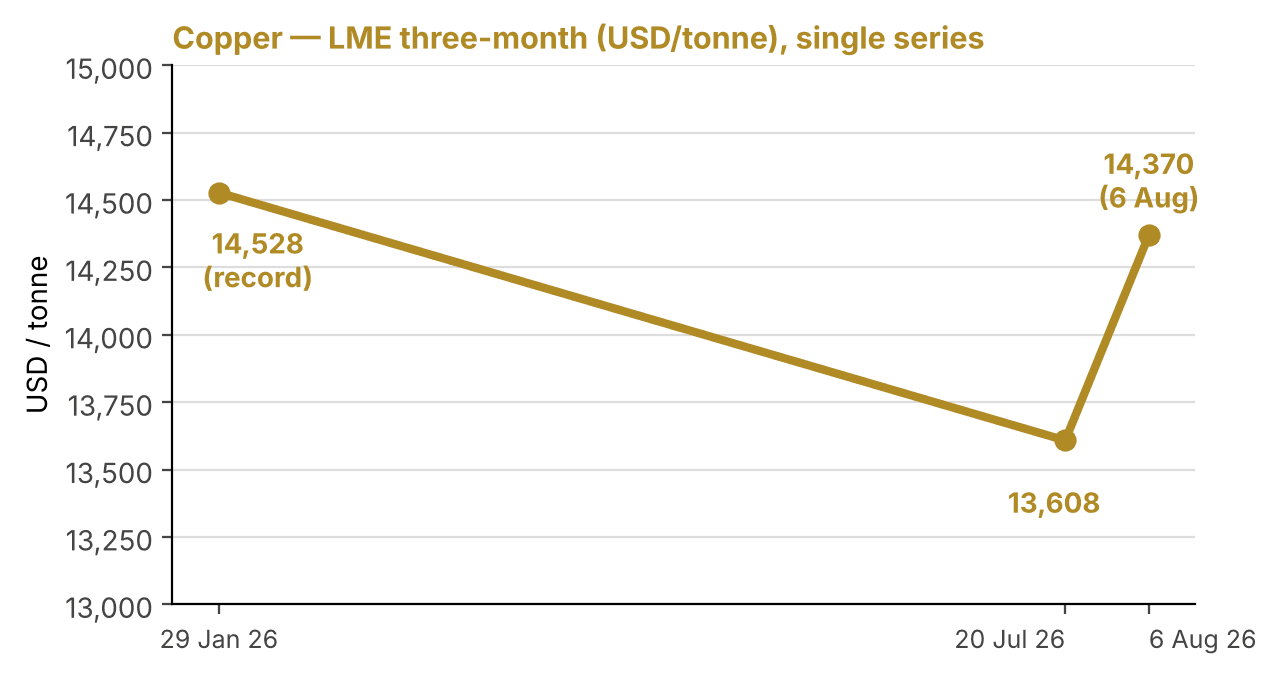
Figure 2 — Copper, LME three-month, single series. Source: LME; Reuters.

Figure 3 — CDF/USD exchange rate, indicative market. Source: BCC conjuncture notes.

Figure 4 — Policy rate trajectory, October 2025 to August 2026. Source: BCC Monetary Policy Committee communiqués.

Figure 5 — 2026 budget envelope: initial law, enacted figure, and promulgated figure. Source: 2026 supplementary finance law; Edition No. 2; Appendix C.
7. Risk Assessment
Risk | Probability | Impact | Recommended action |
|---|---|---|---|
Cumulative mining fiscal and regulatory load (export ban, cobalt quotas, 55% by-product taxation) | High | High | Investors: build by-product taxation into project economics now, especially for germanium and rare-earth recovery. Policymakers: publish objective waiver criteria and timelines. |
Washington and Doha processes stalled on FDLR/RDF sequencing; fighting persists in the east | High | High | Investors: maintain conservative security provisioning on any eastern exposure; assume no peace dividend in the base case. Policymakers: ring-fence security spending. |
FATF mission outcome unknown; October plenary decision pending | Medium | High | Investors: avoid repositioning on the expectation of a withdrawal before the October plenary. Policymakers: prioritise demonstrable enforcement outcomes over further legislative output. |
The BCC has published no explanation for the 548-million-USD July reserve drawdown | High | Medium | Investors: track weekly reserve notes as the primary early-warning series; silence on a move of this size is itself a risk indicator. Policymakers: publish the composition of FX interventions. |
Unreconciled gap of 571 billion CDF between the enacted and promulgated budget envelopes | Medium | Medium | Investors: treat the H2 envelope as a range. Policymakers: settle the gap via the Budget Ministry's first execution report. |
Q1 2026 copper export volumes disputed between the Mines Ministry and Reuters logistics data | High | Medium | Investors: do not build volume-based revenue models on a single series; reconcile against customs receipts where available. |
Copper strength partly reflects a supply-risk premium tied to Congolese policy signals | Medium | Medium | Investors: stress-test exposures against a reversion toward the budget assumption. Policymakers: recognise that the same posture supporting prices raises the fiscal cost of miscalibration. |
Opportunities
Opportunity | Probability | Recommended action |
|---|---|---|
Reserve rebound restores the buffer lost in July and supports continued gradual easing | Medium-High | Local-currency borrowers should watch for further easing if the September inflation print stays contained. |
Standardised-invoicing enforcement opens a domestic revenue gain without new tax rates | Medium | A durable own-revenue uplift would reduce reliance on market instruments and improve the debt trajectory. |
FATF grey-list exit in October would ease correspondent-banking friction system-wide | Medium | This is the least-priced positive on the calendar and the one whose transmission to private-sector credit is most direct. |
8. Outlook
8.1 Short Term — Next 30 Days (through early October 2026)
The FATF mission outcome is the determining item: its confirmation, either way, will move the Banking Sector and Investment Climate scores materially. The policy rate should remain at 12.5% pending the September inflation print. Watch for early operator responses to by-product taxation, any BCC commentary on the July reserve movement, and the Budget Ministry's first execution report against the promulgated envelope, which should also settle the figure discrepancy.
Expected decisions: no Monetary Policy Committee meeting is scheduled in the window; ministerial waiver determinations under the concentrate export order are possible.
Downside risks: an adverse or delayed FATF finding, or a resumed reserve drawdown without explanation.
8.2 Medium Term — Three to Six Months (Q4 2026 – Q1 2027)
The October FATF plenary is the decision point on grey-list exit, whose practical consequence would appear in correspondent-banking terms rather than headline indicators. Q4 budget execution against a contested envelope is the main fiscal test, with invoicing enforcement the variable most likely to determine whether own-revenue assumptions hold. In mining, the question is whether by-product taxation changes recovery behaviour on critical minerals, which would surface in germanium and rare-earth output data before it shows up in copper or cobalt volumes.
Investment opportunities: early positioning on Congolese bank exposure ahead of a possible grey-list exit; local smelting and refining capacity, where demand is created by regulation ahead of the market.
Downside risks: a metals-price correction coinciding with 2027 budget preparation; a deferral of the FATF decision to 2027.
8.3 Long Term — Six to Twelve Months (through mid-2027)
Two trajectories are diverging, and the twelve-month reading depends on which dominates. On one side, reserve adequacy, IMF programme standing, a possible grey-list exit, and demonstrated market access point toward deeper capital-market integration. On the other, cumulative mining regulation, discretionary administration, and an unresolved eastern conflict sustain a risk premium that limits how much of that integration converts into actual investment. Nothing in August resolved this tension; the month sharpened it.
The central assessment carried from Edition No. 2 is reinforced: the DRC's macro-financial trajectory is holding while its public-policy risk is rising. Over a twelve-month horizon, governance predictability will determine the trajectory of the business climate more reliably than any macroeconomic variable.
9. Strategic Insights
The Five Most Significant Developments of the Month
By-product taxation on a 55% valorisation coefficient. The least-reported and most consequential measure of the month, since it falls on the integrated operators the export ban was thought to spare, and penalises critical-mineral recovery exactly as the state encourages it.
The reserve rebound to 8.01 billion USD. It restores the buffer lost in July and answers half of the previous edition's central question; the other half — the cause of the drawdown — remains unanswered.
Promulgation of Law 26-032 and the 571-billion-CDF gap it reveals. Procedurally routine, analytically awkward: it installs a quarter-billion-dollar uncertainty at the heart of the H2 fiscal framework.
LME copper at 14,369.50 USD/tonne on disclosure of the ban. The move demonstrates how directly Congolese policy now shifts the global copper curve, raising the cost of any future miscalibration.
The FATF mission passing without a published outcome. The highest-value unknown at cut-off, and the one whose binary result is most likely to reprice Congolese bank credit in either direction.
Cross-Sector Linkages
This month's developments read better together than apart. By-product taxation and the concentrate export ban form a single value-capture programme, but the fiscal layer inverts its incidence: where the ban spared integrated operators, the tax targets them. Value-capture policy and industrial policy are therefore pulling in opposite directions, and operator response will emerge from that contradiction.
Likewise, the reserve rebound and franc stability are a single event, not two. Reporting them separately produces a more favourable impression than the combined figures support, since July's currency stability was financed by the drawdown that August only partly repairs. The BCC's silence on the movement's origin prevents any assessment of its sustainability.
Finally, governance and budget policy converge. The supplementary budget's reliance on market financing raises the value of a grey-list exit, since cheaper correspondent banking directly lowers the cost of the financing strategy this budget assumes. Governance reform has become a fiscal instrument, which is why the FATF outcome weighs more heavily on the outlook than the level of the policy rate.
The Month Ahead — Watchlist
FATF on-site mission — whether it took place, its conduct, and any published signal ahead of the October plenary. Carried unresolved from Edition No. 2.
Weekly BCC reserve data — whether August's recovery holds through September, and whether an explanation for July's drawdown is published. Carried partially resolved from Edition No. 2.
Operator response to by-product taxation — the first operator and Chamber of Mines response, and any waiver determination under the concentrate export order. Broadens the Kamoa-Kakula item carried from Edition No. 2.
Weekly INS inflation prints — a sustained breach of 0.20% would end the easing cycle. Carried with no data from Edition No. 2.
First Budget Ministry execution report against the promulgated envelope, which should reconcile the 571-billion-CDF gap. New this edition.
World Bank Country Partnership Framework progress from consultation to commitment. Carried with no movement from Edition No. 2.
Appendix A — Fixed Source Panel (15 DRC-Focused Sources)
The same fifteen sources are monitored on the last calendar day of every month at 12:00 (Eastern Time). A source is replaced only if it permanently ceases publication, becomes unavailable, or its quality deteriorates significantly; any replacement is disclosed in Appendix B.
Source | Domain | Coverage | Frequency |
|---|---|---|---|
1. Zoom Eco | zoom-eco.net | Daily financial and economic news | Daily |
2. DeskEco | deskeco.com | Daily economic news | Daily |
3. Actualité.cd | actualite.cd | General and economic news | Daily |
4. Radio Okapi | radiookapi.net | National broadcaster, economics desk | Daily |
5. 7sur7.cd | 7sur7.cd | General and economic news | Daily |
6. Mediacongo | mediacongo.net | General and economic news | Daily |
7. Banque Centrale du Congo | bcc.cd | Conjuncture notes, MPC communiqués, statistics | Daily / weekly |
8. Ministry of Finance | finances.gouv.cd | Budget execution, auctions, AML/CFT | Daily |
9. Ministry of Budget | budget.gouv.cd | Budget preparation and execution | Daily |
10. Ministry of Mines | mines.gouv.cd | Mining policy, production and exports | Daily |
11. RDC Finances | rdcfinances.com | Economic and financial analysis | Daily |
12. ODEP | odep-rdc.com | Public-expenditure monitoring (civil society) | Weekly |
13. CREFDL | crefdl.org | Public finance and local governance research | Weekly |
14. ITIE-RDC | itierdc.net | Extractive-industries transparency | Monthly |
15. FEC — Fédération des Entreprises du Congo | fec-rdc.com | Employers' federation; business-climate positions | Weekly |
Appendix B — Source Panel Changes
No changes for this edition. The panel remains as set at Edition No. 2, when the Fédération des Entreprises du Congo was added as the fifteenth source. ANAPI, the national investment-promotion agency, remains first reserve should a replacement become necessary.
No source was removed. No source ceased publication, became unavailable, or saw its quality deteriorate significantly during the reference period.
Six of the fifteen panel sources contributed to this edition: Zoom Eco, Actualité.cd, 7sur7.cd, Mediacongo, the Banque Centrale du Congo, and the Ministry of Finance. The remaining nine produced no material meeting the significance threshold during the period. This is recorded rather than concealed, and Edition No. 4 will query the non-contributing sources directly rather than relying on general search.
Sources consulted outside the fixed panel — including Reuters, TRT Afrika, ACP, Invest-Time, Agence Ecofin, the IMF, LME quotations, and the US Department of the Treasury — are cited inline where used. They supplement the fixed panel without replacing it, and their use is disclosed rather than substituted. This edition relied on such sources more heavily than the panel, which is recorded here rather than presented as panel-derived work.
Appendix C — Methodology, Quality Standards and Limitations
Periodicity. This is the second monthly edition, covering 1–31 August 2026. The edition ledger reads: Edition No. 1 (pilot, weekly, 29 June – 8 July 2026), Edition No. 2 (1–31 July 2026), Edition No. 3 (1–31 August 2026). Edition No. 2 serves as the comparison baseline throughout Sections 1, 5 and 6. Subsequent editions are published on the last calendar day of each month at 12:00 (Eastern Time).
Period test. Only developments occurring or first disclosed between 1 and 31 August 2026 are reported as new in Section 3. Items from prior editions that remain live appear in Section 3 bis with an updated position, and are not re-narrated. Post-period observations, where retained for reference, are labelled as such and carry no month-on-month arrow.
Fact and analysis. Each entry in Section 3 separates a factual summary from an implication explicitly identified as such. The scores in Section 1, the risk probabilities in Section 7, and all forward-looking statements in Section 8 reflect the author's judgement, not reported fact.
Conflicting Information Identified During the Period
Supplementary budget envelope. Edition No. 2 recorded the enacted envelope at 50,295 billion CDF, described as a 7.4% reduction against the initial law. Law 26-032, promulgated 7 August, is reported at 50,866.3 billion CDF, described as a 6.4% reduction. The gap is 571 billion CDF, roughly 250 million USD at prevailing rates. No panel source explains it. It may reflect a late revision at promulgation, a reporting error in either figure, or a difference in scope. Both figures are carried and neither is treated as superseding the other; the Budget Ministry's first execution report should settle the question.
Q1 2026 copper export volumes. Mines Ministry provisional statistics show 823,886.88 tonnes exported January–March 2026, against 794,422.01 tonnes in the same period of 2025 — an increase of roughly 3.7%. Reuters logistics data show a 14.6% decline to roughly 955,000 tonnes, against nearly 1.09 million tonnes a year earlier. A third basis appears in export-ban coverage: 696,725 tonnes of cathode plus 53,926 tonnes of concentrate, totalling 750,651 tonnes. The three figures are not reconcilable on published information; they differ in both level and direction, most likely because they measure different things — ministry declarations, shipment logistics, product-category breakdowns. No volume-based revenue estimate in this report relies on any one of them, and Section 6 records the indicator as disputed rather than adopting a series.
Copper price series. Three copper prices circulated during the period: LME three-month at 14,369.50 USD/tonne on 6 August; a BCC reference price of 12,885 USD/tonne; and the DRC mining data portal reference at 12,498.35 USD/tonne on 6 September. These are separate series measuring different things and are not comparable. This report quotes LME three-month as its single headline series throughout. The portal reference is shown once in Section 6, labelled and without an arrow. Mixing these series produces a false impression of price decline; this was the principal analytical error corrected in this edition.
Derived figure. The 30 July reserve level of 7,917.0 million USD shown in Figure 1 is derived, not reported: it equals the 6 August figure of 8,009.81 million less the stated weekly change of 92.79 million. It is included to complete the series and is marked as derived. All other reserve points are as published.
Items excluded as out of period. Two items flagged during quality review were excluded from this edition after date verification. Ivanhoe Mines' revision of 2026 Kamoa-Kakula guidance to between 290,000 and 330,000 tonnes from 420,000, and a sulphuric-acid shortage projected to reduce copper supply by 125,000 tonnes in 2026, both date from April 2026. They are material structural context but not August developments, and are not reported as such.
Regional disambiguation. Information relating to the Republic of the Congo (Brazzaville), denominated in FCFA, was excluded. Only data for the Democratic Republic of the Congo is used, and currency and institution names are verified before any source is used.
Limitations. No official business-confidence index exists for the DRC; Section 6 notes this rather than substituting a proxy. Weekly BCC data are provisional and subject to revision. Metal prices are market quotations, not realised Congolese prices, which differ by grade, contract, and logistics cost. August produced only seven in-period developments meeting the significance threshold, below the brief's 10–20 range; the count was held rather than padded with prior-period material.
Political neutrality. This report assesses economic and financial consequences only. Characterisations of the security situation and peace processes are limited to their documented economic effects and take no position on the underlying political questions.
About the Author
Alain Pae — Economist | Independent Researcher
Ottawa, Canada
Alain Pae is an economist and independent researcher based in Ottawa, Canada, with more than 30 years of professional experience in Canada and internationally across the public and private sectors. His expertise spans economic analysis, financial systems, public policy, and the geo-economic issues affecting emerging markets, with a particular focus on economic development, public policy transformation, and the dynamics of extractive industries — notably mining and energy — and strategic infrastructure. He also conducts research on security, stability, and development in Africa's Great Lakes region, examining the interaction between economics, natural resources, infrastructure, governance, and geopolitics.
Publication and Rights. © 2026 Bahigom Analytics Inc. All rights reserved. Published by Bahigom Analytics Inc. — the independent financial and regulatory intelligence on the Democratic Republic of Congo. Copyright in this report is owned by Bahigom Analytics Inc., which holds all rights, including the right to publish, license, or reproduce it. Author: Alain Pae.
The analysis, scores, and forward-looking statements in this report are the author's own. Nothing in this report constitutes investment, legal, or tax advice.
Contact: info@bahigomanalytics.com